They say when one door closes, another opens. But what happens when that door opens to nowhere?
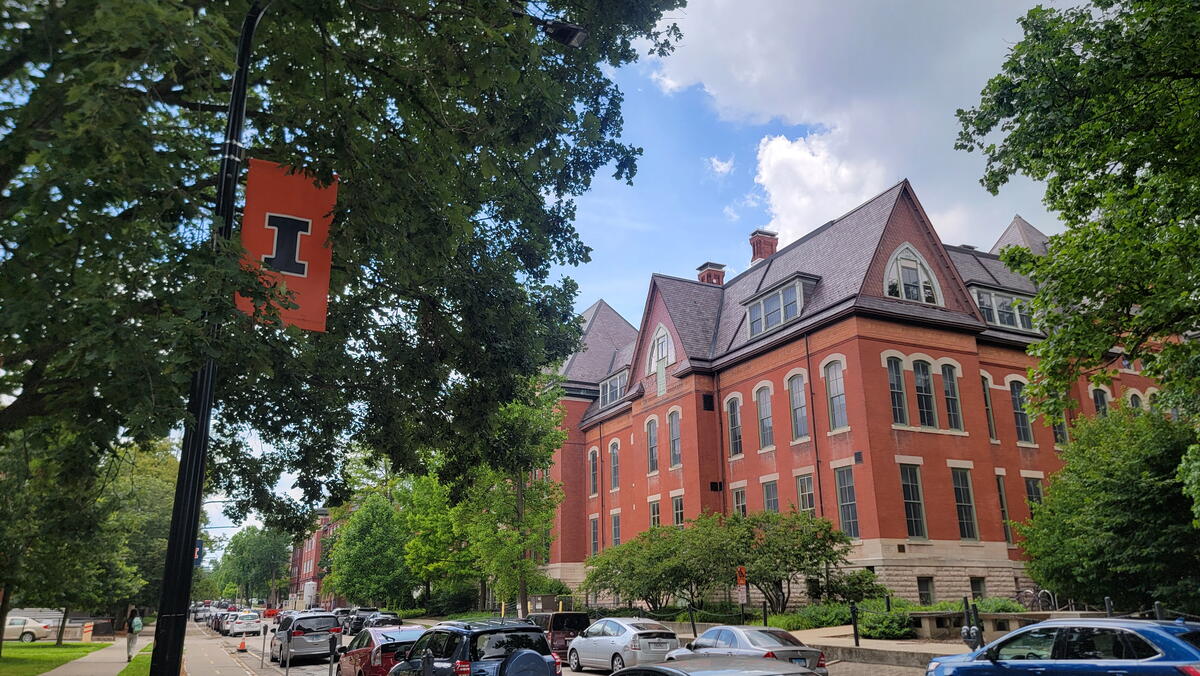
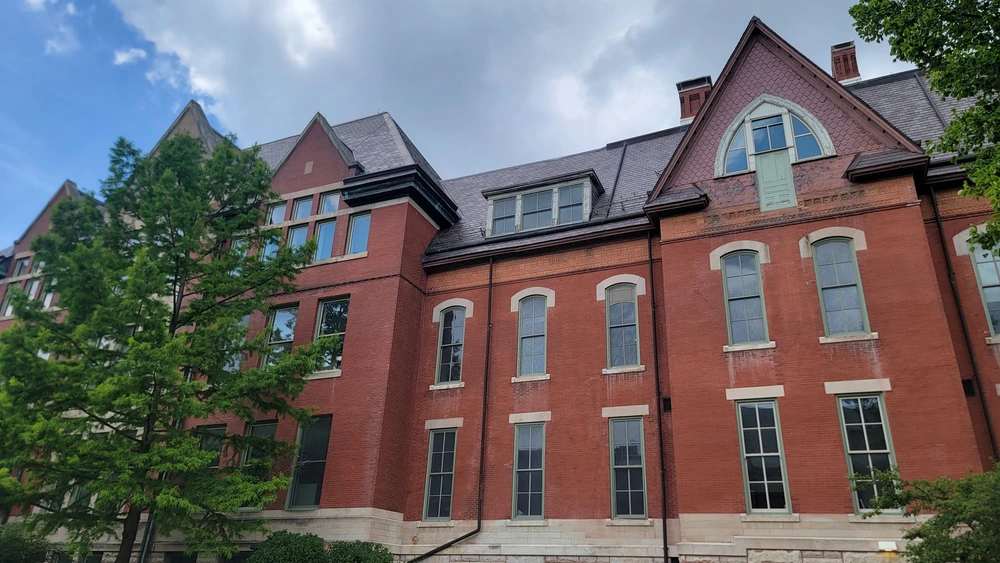
On the east side of the University of Illinois Urbana-Champaign's Natural History Building, a door sits suspended several stories above the ground, with no obvious way to reach it. Open it, and you would appear to step straight into thin air.
I tried not to think about it.
But once a question takes hold, it's hard to let go. Someone had put that door there, and someone had once needed to use it. And if the building's history held an explanation, surely it couldn't be that difficult to find.
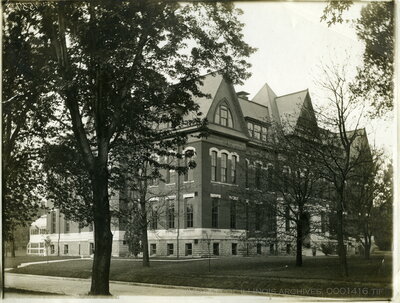
I started with the archives. Somewhere among the building's old photographs, there had to be a clue. But most images showed the building from the wrong angle, leaving the door out of view. In one photograph taken from just the right spot, a tree stood directly in front of it, obscuring the very detail I was trying to see.
It was almost comical. The closer I got to an answer, the more the building seemed to hide it.
The search for an explanation became an investigation into the Natural History Building itself. What began as a question about one strange doorway led me into the history of a building shaped by decades of additions, makeshift spaces, fires, and renovations. The door was only the beginning.
A maze of halls and makeshift rooms
When Steve Marshak arrived at Illinois, the Natural History Building had become a maze of spaces, passageways, and improvised work areas. Built in stages beginning in 1892, the building grew as the university expanded, and additions and decades of smaller renovations reshaped its interior piece by piece, accumulating decades of practical fixes until its original layout became hard to recognize.
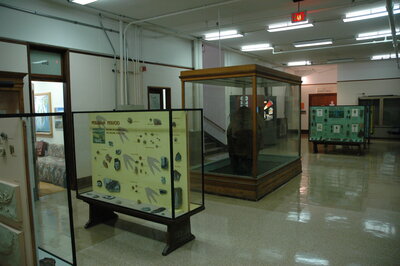
"It was a very chaotic building because it had been built [and renovated] in pieces," said Marshak, a retired professor who was on the geology faculty at Illinois for 35 years, during which he served as head of the geology department (now the department of earth science & environmental change) and later as director of the school of earth, society & environment.
As offices, laboratories, and museum spaces multiplied, they blocked off and repurposed hallways. Getting from one part of the building to another could require detours through different staircases and floors.
"You could only get around the building without hitting a dead end in the basement or on the first floor," Marshak said.
The basement was particularly memorable. In its older section, the ceilings were low, the lighting poor, and some rooms had no windows. Graduate students worked in closet-sized spaces separated by plywood partitions. Students called the area the "catacombs." Some students even claim that the elevators would open and close on their own.
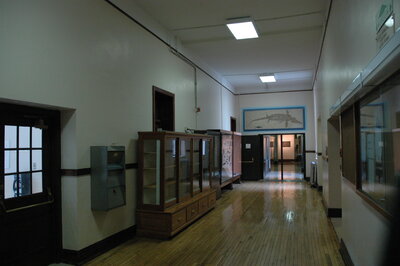
"It was really, to be honest, not a very pleasant building," Marshak said.
The oddities weren't confined to the basement. Marshak recalled how his cohort of graduate students, whose workspace was tucked into what was essentially the building's attic, reached it by a narrow staircase called the "stairway to heaven" by its occupants.
Elsewhere, office space was improvised from whatever the building could offer. Marshak recalled that professor Don Henderson, a mineralogy professor, was assigned an office that had once been a bathroom, with the toilets removed to make room for a desk. Even Marshak’s own office had been built over part of the grand staircase in the building’s north entrance, sacrificing a piece of the building’s original design to create more workspace.
And in the basement, behind a large wooden door, another reminder of the building's earlier purposes waited.
Cold storage, a mummy, and a skeleton
Marshak recalled an old-fashioned wooden door on the basement's north wall that led to what he believed had once been a refrigerated storage room. Given the building's history as home to the physiology department, the room may have held specimens or cadavers, though its exact use remains forgotten.
But it found a new role.
One day, Marshak entered the building and encountered a group of people, including someone wrapped entirely in bandages. They were filming a student production called "The University of Illinois vs. A Mummy." In one scene, the mummy emerged from that very room.
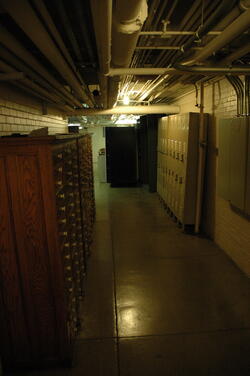
It's difficult to imagine a more fitting setting for a student horror film.
The building's history offers another tale with a more direct connection to the supernatural — or at least to the art of startling someone in the dark.
In June 1897, lightning struck the 5-year-old Natural History Building during a thunderstorm, setting the upper story on fire. A report published in The Daily Illini on Sept. 24 described professors, students, and others rushing to rescue books, scientific equipment, and furniture. Firefighters battled the blaze as rainwater damaged the building's contents. The newspaper said the cost to repair the building was ultimately about $5,000, equivalent to more than $200,000 today.
The same report recounted a smaller incident from the following night. A student hired to watch the building had been instructed to close the windows if rain returned. His lantern went out, forcing him to navigate the rooms by flashes of lightning.
He entered a room and waited for another flash to locate the windows. Instead, the light revealed a skeleton belonging to the physiology department, standing about a foot in front of him.
"With a yell the student made for the door," the newspaper reported, "and the remainder of the night the skeleton did all the watching done in that part of the building."
Whether the encounter unfolded exactly as described, the story remains in the historical record — an unsettling footnote in the history of a building that has never lacked for unusual corners.
Fire, decay, and a new beginning
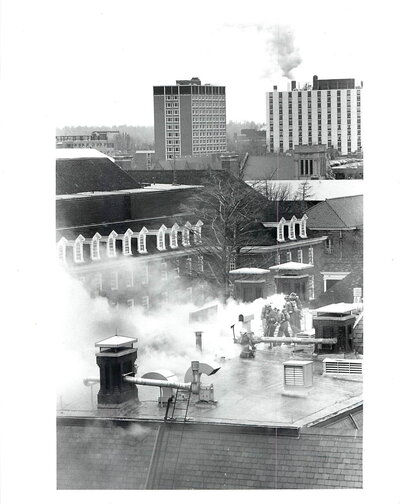
The building's more modern history was no less dramatic.
Marshak was away on a field trip in Arizona with students during spring break in 1991. After being off-grid for a week, in the pre-cellphone days, they checked into a motel to clean up for their flight the following morning. One of the students, who had just finished his dissertation and was about to deposit it, called home and learned that the Natural History Building had caught fire.
Did the dissertation go up in flames? Fortunately not, but smoke and water caused extensive damage. Firefighters had pumped immense amounts of water into the building, and it streamed through offices and classrooms in the north end. A thick copy of the Handbook of Chemistry and Physics sat on Marshak's desk. Since the water was smoky and acidic, a persistent drip bored through the book like a bullet hole.
"I pretty much had to throw out everything in my office and start over again," Marshak said. Years later, concerns about the building's structural integrity led to a much larger reckoning.
During planning for a small room renovation, workers discovered extensive termite damage in the building's 1892 wooden portions. An ensuing inspection revealed a more serious problem: the concrete used to build the new part of the building had been improperly laid, so the floors were sagging and failing. The Dean sent a message: "Evacuate immediately, and take only your personal possessions!"
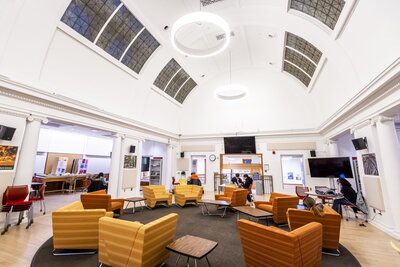
In a multi-year project that began in 2014, the building was largely gutted and rebuilt, but its history wasn't discarded. Original doors and wood trim were refinished, limestone from former bathroom partitions was reused to line the south-side entrances, and salvaged wood flooring found new life in the building's central space, now called The Core. The grand staircase, once partially sacrificed to make room for offices, was restored. The “stairway to heaven” remains, too, though it now leads to a maintenance space rather than to student offices.
Even in the building's attic, the past remains visible. Some of the support beams still bear charred scars from the 1991 fire, a reminder that the building's history wasn't entirely erased by its transformation.
The result is the Natural History Building visitors know today: a modern facility that preserves the character of its Victorian Gothic architecture while providing 21st-century infrastructure for modern teaching and research.
“It's one of the prettiest buildings on campus,” Marshak said.
A door left behind
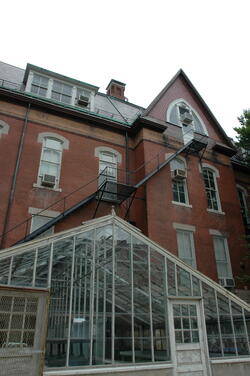
So what of the door that started the investigation?
By this point, I had spent more time thinking about the door than I care to admit. The answer, it turned out, was hiding in an archive I hadn't known to look through.
Lana Holben, assistant to the director of SESE, pointed me toward another collection of historical photographs. There, at last, was the missing piece: an image of the fire escape that once stood outside the building. It had opened onto a staircase that was no longer there.
I wanted to make sure there wasn't more to the story on the other side, too. With help from another communications colleague, I gained access to the laboratory owned by the School of Integrated Biology. I stood on the other side of the very door I'd been trying to understand. No handle, and a heavy counter blocked it. The door seemed sealed forever.
Marshak confirmed the door had once led to the fire escape, though he couldn't recall when they removed the stairs. He offered a practical explanation for why the door survived the building's major renovation.
"It would have been quite pricey to take it out and replace it with a window because they would have had to do brickwork," he said. "So they just left it as a door."
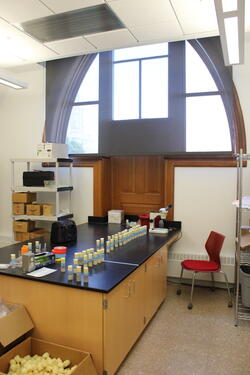
The explanation is ordinary enough. But after learning about the building's maze of makeshift rooms, its eerie basement, and the fires and renovations that shaped its history, the door feels like more than an architectural oddity. It's a reminder of a building whose past still peeks through its modernized walls.
The staircase is gone. The door remains, blocked from within and sealed, for all practical purposes, away from the world.
I suppose that should satisfy a curious mind. The mystery has an explanation, and the building has a history far more interesting than a single doorway. Even a door that leads nowhere can open onto a story.
But I still find myself looking up when I pass it.
Some questions, it seems, are easier to answer than they are to stop asking.
Dave Evensen of the College of Liberal Arts & Sciences contributed to the research for this article. The University of Illinois Archives provided historical photographs and documents that supported the investigation. The UI Histories Virtual Campus Tour project also provided historical photographs.