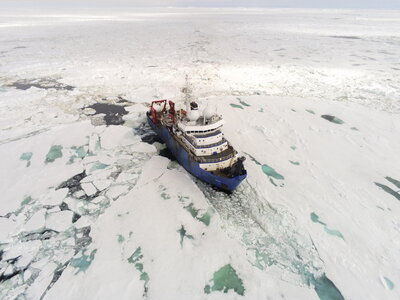
For four or five days, the research vessel barely moved.
Locked in Antarctic sea ice, the ship crept forward only about 100 yards a day as researchers waited for conditions to improve. For many aboard, the delay was frustrating. But for Rose Malanga and her advisor, professor Ellen Buckley, the ice was exactly what they had come to study.
For Malanga, then a first-year PhD student in the Department of Earth Science and Environmental Change at the University of Illinois Urbana-Champaign, the expedition offered a chance to study something she had previously observed mostly through satellite imagery: the different processes that cause sea ice to form and grow, and whether those processes are changing as the climate changes.
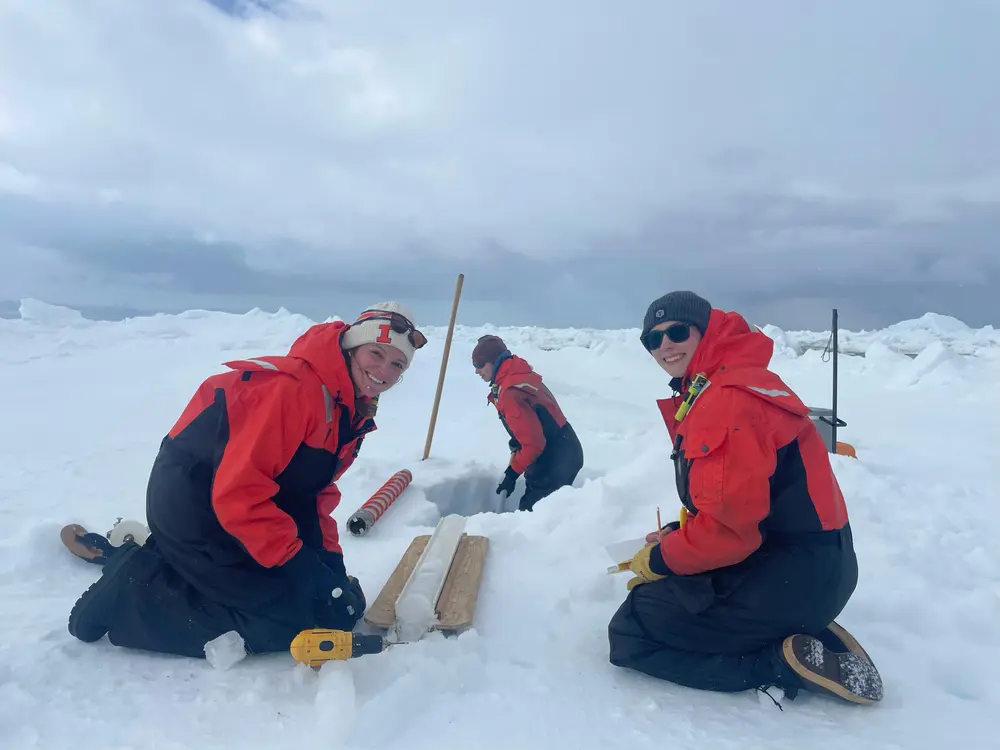
Each morning before sunrise, Malanga and Buckley climbed to the ship's bridge to scan the ice below for a stable floe where they could collect samples. Once they identified a suitable patch of sea ice, they boarded a small Zodiac raft and headed out across the water, searching for ice thin enough to drill through but stable enough to stand on safely.
“It was awesome,” Malanga said. “I think the craziest part was that you wouldn't really feel that you were moving on it, but if you looked out to the horizon, you could see that you were bobbing up and down.”
Out on the ice, the silence was almost complete.
“If you were not making a noise, if the Zodiac engine was turned off, it was just the sound of the water lapping,” she said.
The wildlife, however, was far less quiet.
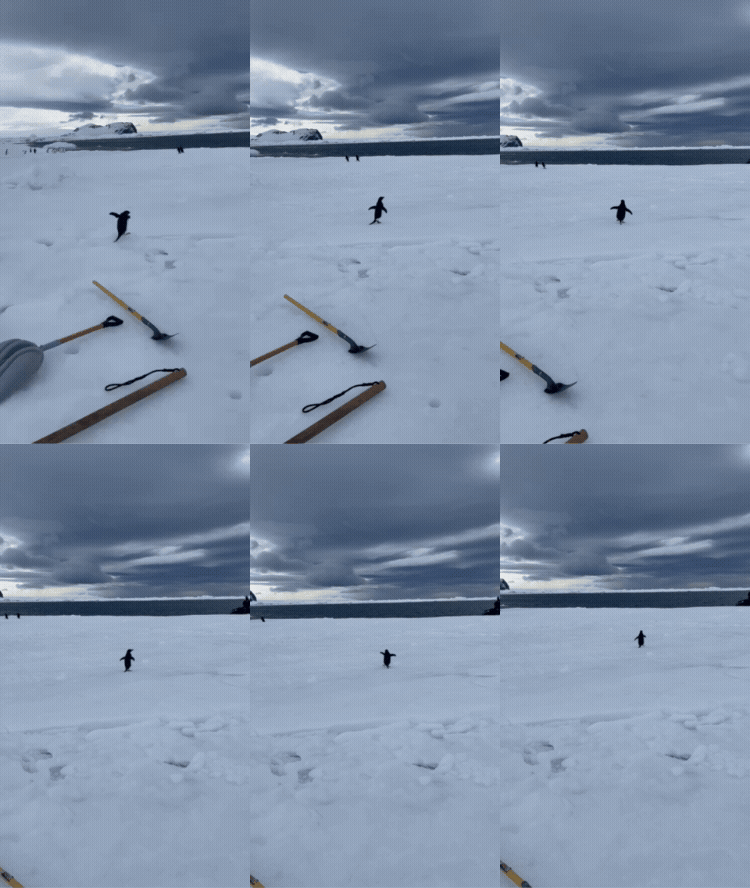
“I saw so many penguins,” Malanga said. “They're like the squirrels of Antarctica.”
The penguins often wandered directly toward the researchers while they drilled ice cores, forcing occasional interruptions to admire their unexpected visitors.
“It was really hard to get our work done sometimes because we were like, ‘Oh, penguin break,’” she said.